A Funeral For Your Tits
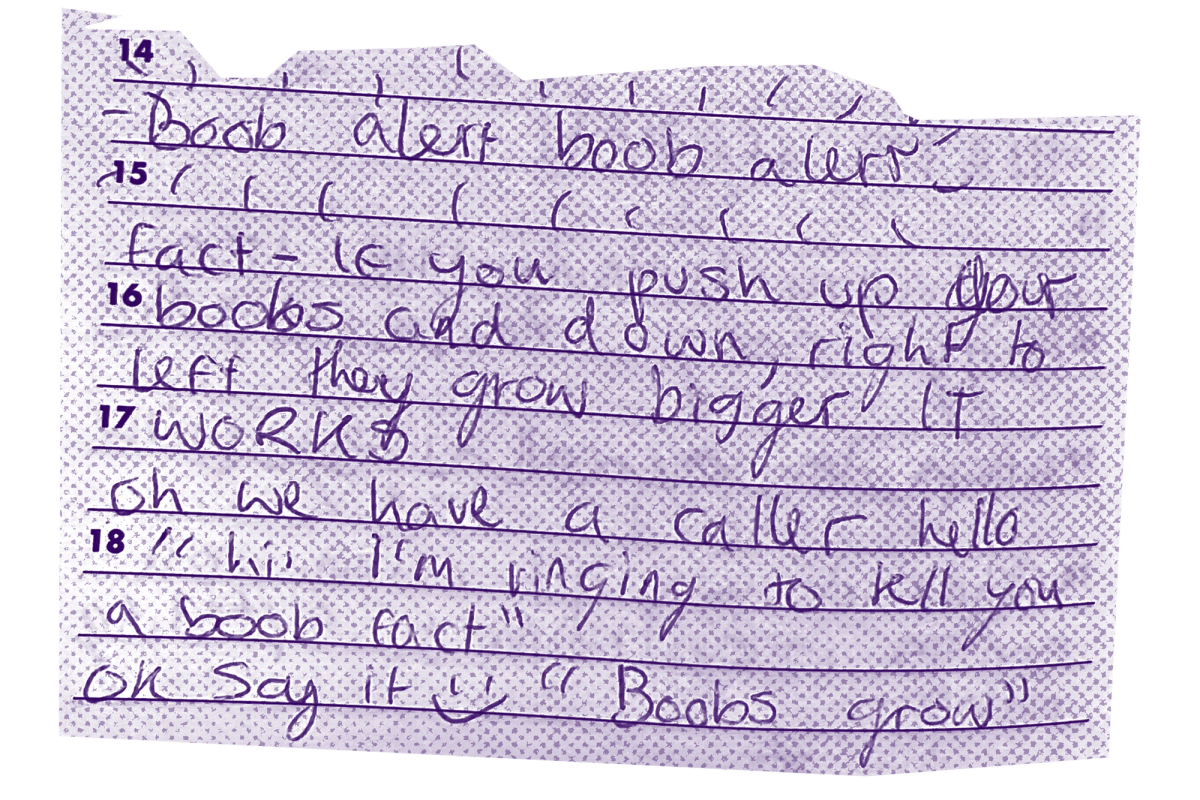
Last year, during a clearout, I found my old diary stuffed in an old suitcase in the attic. Inside were the insatiable scribbles of a 13-year-old teenager, giddily bestowing upon me the secret of their latest wisdom: “FACT: if you push up your boobs and down right to left they grow bigger,” and “IT WORKS.”
Obviously, it didn’t. I’m not sure where that all-caps certainty came from, but at a certain point I was willing to believe, or try, anything.
But despite years of expertly stuffing socks down my bra, photoshopped tits, squeezing my boobs together with my elbows, and sketching on cleavage with an eyebrow pencil, I’m blessed (or cursed, as younger me would have put it) with itty bitty titties. My boobs are a size AAA, roughly the size of two plums. I was once gifted a hand-me-down bra from my girl-in-the-year-above neighbour. Three sizes too big, I clung to it as kind of a status symbol. Wearing it felt like a rehearsal for something bigger, better, perkier. I filled the gaps with four silicone chicken fillets, pushed my boobs every which way, and waited for the day the rehearsal would end.
I vividly remember my first time being fondled. I had dressed up in the sluttiest dress I could find on eBay; it had gigantic holes absolutely everywhere and left nothing to the imagination. It was like the dress had given up trying to contain me and just started organising me into sections. Tom was in the year above me and smelled of mint and Abercrombie & Fitch. It was the first time I’d been to his house, and it was absolutely freezing. He asked if he could put his hands on my ‘3 Sizes Bigger Boost Super Maximise Push Up THICK Padded Bombshell size AAA’ bra to regain the feeling in his fingers.
To his disappointment, his hands did not warm up.
To say that a lot of women don’t like their boobs is hardly a revelation. We’re taught, systematically, almost from birth, to despise our bodies and to perform otherwise.
I remember my first burlesque class. I signed up because my friend said it had done wonders for her self-esteem, which felt both promising and suspicious. The word burlesque means to mock, to exaggerate, to play. But mostly, for me, it was an hour every week standing in front of a mirror, sometimes in expensive lingerie, often crying into the shoulder of the girl next to me, who also despised her boobs.
It wasn’t until I discovered the dick-swinging, boxer-flinging world of drag kinging that I really started loving my tiny tits. They’d stopped being a failed attempt at femininity and became something else. Something optional. Something I could play with, masculinise, exaggerate, or even just ignore. It turns out teenage me had been in drag this whole time.
I’m obviously not the only trans person who grew up feeling wrong in their body.
For years I carried this low, constant grief without knowing where to put it. At one point I was told it came from a past life, and I believed it because it was simpler than admitting I didn’t understand myself. A trans-masculine friend was the first person to name what it was: dysphoria.
Grief is not a stranger in queer communities; it just doesn’t always get called that. It lingers in the quiet realization you can’t go home in the same way anymore, in the slow negotiation of being seen, or in losing versions of yourself that felt easier, more legible, more acceptable.
Historically, queer people have grieved together through vigils, protests, and collective refusal. Grief has taken many forms: protest during the AIDS epidemic, reckoning in movements for trans lives, honouring and remembering those lost, insisting that something or someone mattered. When the structures meant to hold grief exclude you, you build your own. You gather, light candles, and say their names.
“Ritual is able to hold the long-discarded shards of our stories and make them whole again,” Francis Weller writes. I don’t think I’d realised how badly I needed somewhere to put all the feelings that didn’t seem to fit anywhere else. I started holding ‘funerals’ for my grief in an attempt to make my own.
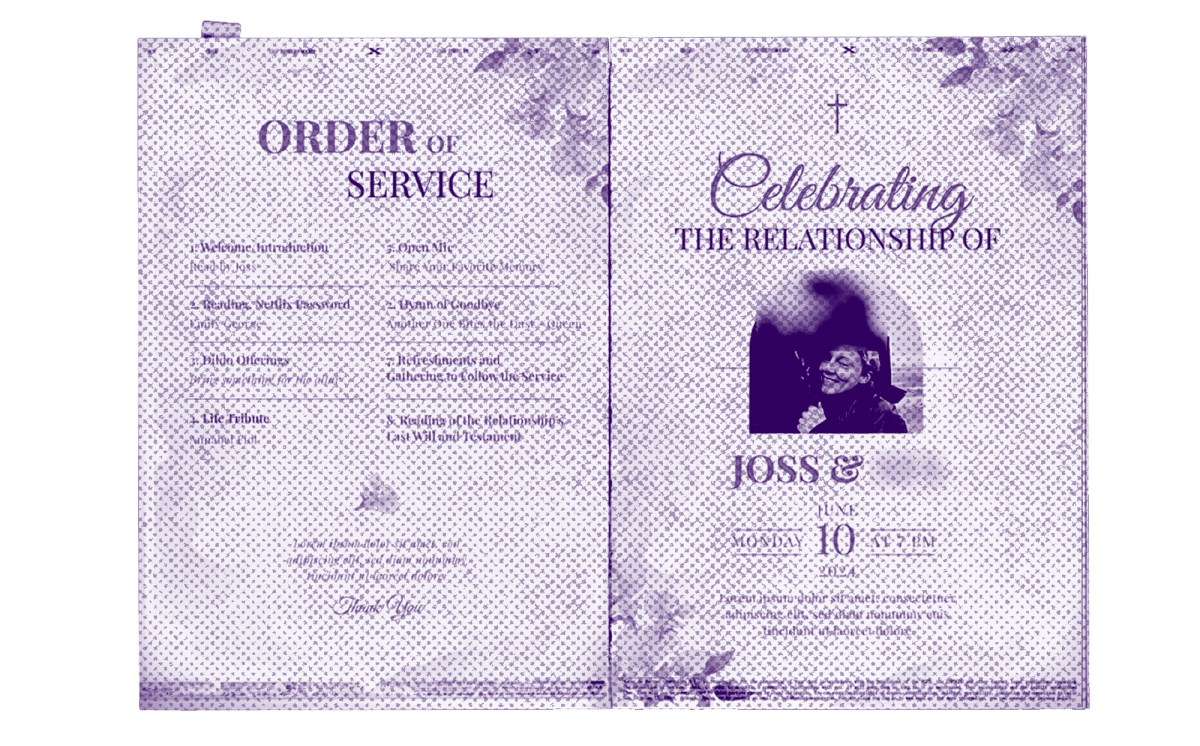
It started almost as a joke. A funeral for the recent end of my relationship, complete with an order of service, damp cucumber sandwiches, hymns, and an altar full of our exhausted sex toys. Our friends turned up wearing all black, and what started as a funny idea became one of the most cathartic and joyful nights of my life.
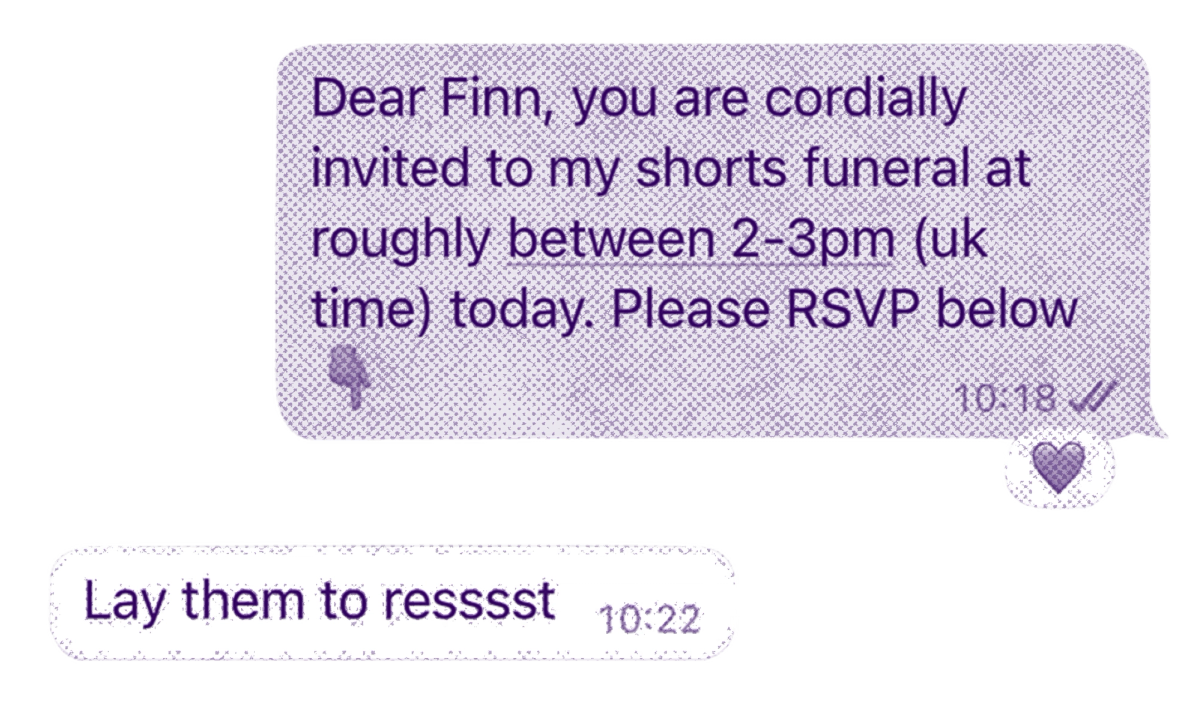
A few months later, I was sexually assaulted on a train in Barcelona. Ritual felt like the only language big enough to hold what happened. This time, I held another funeral, but for the shorts I was wearing. My friends joined me on video call, encouraging me to reclaim the moment by performing a ritual where I (unsuccessfully) set the shorts on fire and then ended up pissing on them in a sort of reclamatory act of closure.
The funerals continued, becoming bigger, weirder, and more communal each time. Somewhere along the way, they stopped feeling like private coping rituals and started becoming a kind of collaborative performance art. At the funeral I held for dropping out of art school, I built a coffin and performed a drag act that was somewhere between The Rocky Horror Show and a TED talk.
The catharsis I felt from these ‘funerals’ led me to want to bring the concept to others, offering it as a workshop at festivals, a space not typically associated with grief.
That’s how Funeral For Your Tits started.
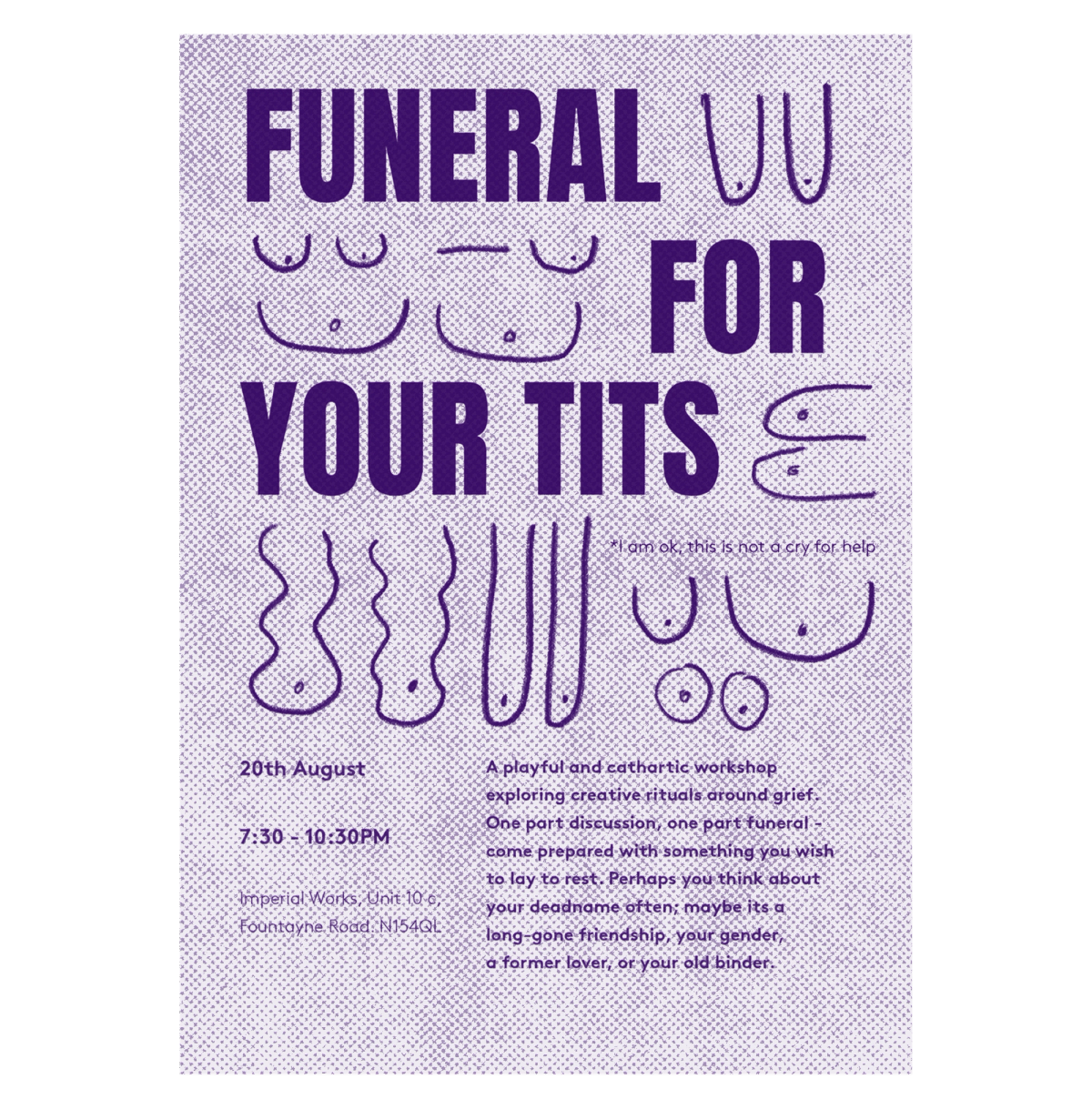
Funeral For Your Tits is a playful yet cathartic space for exploring creative rituals around queer grief. The workshop blends discussion with ritual, offering a communal ‘funeral’ where participants can symbolically lay something to rest with a community of people who understand, or at least recognize the shape of it.
You might find yourself pushing a complete stranger through a cushion fort made to look like a vulva, laughing and crying at the same time and screaming “SHE’S REBORN” as she emerges. And you might end up holding her as she sobs, letting go of her birth family and stepping into her chosen one, people who accept and celebrate her transness.
You might also find yourself at a life drawing funeral, where you all sit in a circle and sketch a stranger’s chest, so he can have art on his walls of something that never felt like his, but that he can see, maybe for the first time, as beautiful.
Society tells us to grieve quietly, quickly, and alone. To move on and to package our losses into something tidy and presentable. But grief doesn’t want to be tidy. It doesn’t follow timelines, and it doesn’t fit into boxes.
Queerness teaches us early that we’re allowed to exist outside the structures we’ve been given and that we can create our own rituals, our own meanings, including how we grieve. Acknowledging my transness meant grieving who I thought I was in order to honour who I always was. It meant letting go of futures that were easier to explain, but it also gave me something back, an understanding that grief can be expansive, even when it feels like contraction. That grief doesn’t have to be linear or resolved. That it can be loud, tender, communal, ritualistic, political, funny, sacred, performative, weird, overwhelming, exhausting, lonely, beautiful, and transformative. All at once.
Grief in queer communities is not just about who or what we’ve lost. It’s about how those losses are seen, or not seen. Which is why it matters that we witness each other, that we build spaces, however temporary, where grief is allowed to exist in its full, messy form.
For me, these strange, inconsistent, too-small-now-too-big tits will always be a part of me. And now the Abercrombie minty fondle sits somewhere in their archive, filed away with everything else. Something I might bring out one day, turn over, maybe even eulogize. But not just yet.
More from Creative


