A Bristol boat sets sail to Gaza
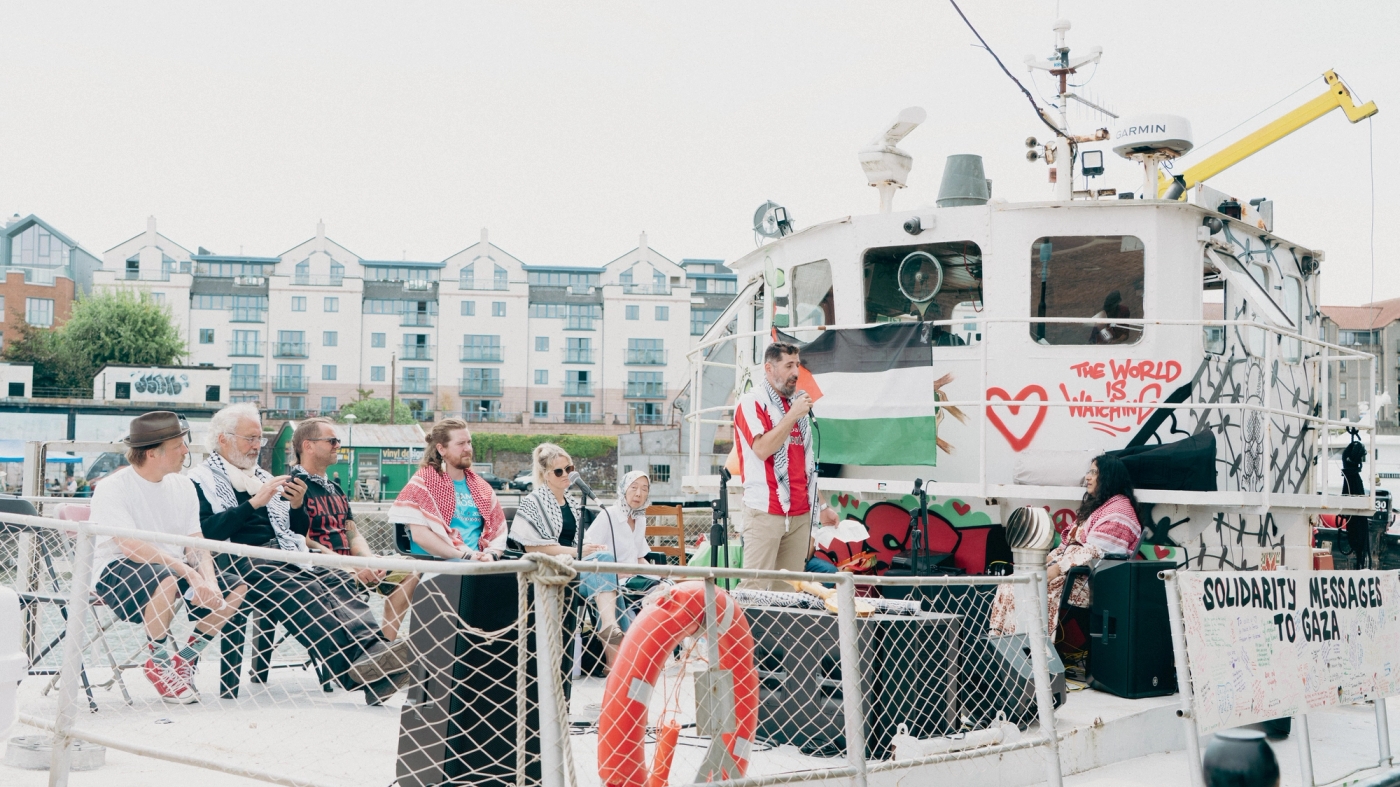
The Palestinian flag hangs proudly aboard the ship. She is painted and decorated with messages of hope and love. The words "The world is watching" are graffitied on in red with a heart. Laid out on deck is a banner with messages to the people of Gaza – children write notes, trace their hands.
On Monday August 17th 2026, The Kate, from the Freedom Flotilla Coalition (FFC), sets sail from Bristol harbour for Gaza, carrying food and humanitarian aid. I’m attending their final day in Bristol before they set off – the crew are finalising preparations, hosting speeches, musicians and art auctions to the public. Some of the crew, like FFC UK Head Iris Haynei and University of Bristol student Channon ‘Chan’ Lawrence, are sailing towards Gaza for the first time. Others, like author, lawyer and organiser Dr. Frank Romano, are travelling for the fifth time.
Romano recounts his four previous flotilla missions that were all blocked or intercepted: some boats having been bombed, others sprayed with acid, several activists being kidnapped, tortured and raped. Since 2010, he reminds us, over 30 flotillas have attempted to break the blockade of Gaza. Each one intercepted, raided or attacked by Israeli forces.
It’s easy to wonder— why are they going again, knowing what they are heading to? What is the point?
Each activist I spoke to today has a different approach, but they all share a deep love for humanity and the people of Palestine. Raed Alghawazi, from the Samir Foundation working to support and rebuild Gaza’s healthcare workforce, says “We always have the hope – even if it does not reach the shore, it reaches the souls of the Palestinian people”. Dr. Swee Ang, an orthopedic surgeon, author and co-founder of charity Medical Aid for Palestinians, has been an activist for 44 years. She tells us, “It began [for me] in 1982, when as an ignorant Pro-Israel Christian doctor I first stepped foot as a volunteer surgeon in Gaza Hospital, in Beirut’s Sabra Shatila Palestinian refugee camp. There I fell in love with a generous, kind, honest and gentle people – the Palestinians”.
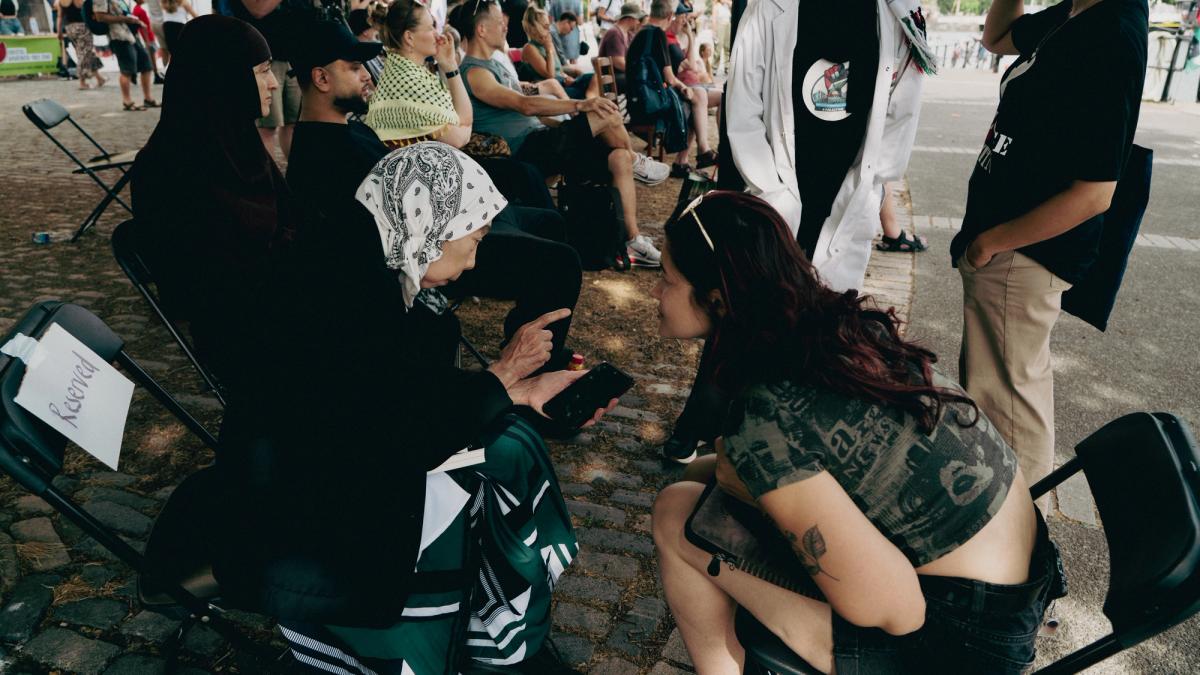
Mina Nadezjda Janssens (author) and activist Dr Swee Ang. Photo by Mitali Shah @_mitulshah
Now that Ang is in her seventies, she is not able to join The Kate’s crew, but she continues fighting and speaking, joining the activists aboard the boat in the days leading to its departure. Addressing the crowds gathered on the harbour, she says “About 3 weeks after my arrival, more than three thousand of them were cruelly massacred. My heart was broken and trampled on, and would have remained dead and buried in the rubble of their bulldozed homes. But the survivors, even while burying their own loved ones, nurtured me back to life with their tears and love. The children filled with courage, hope and dignity inspired me, and gave me strength to walk on with them”.
There is a pain and there is a love in the way she speaks about the Palestinian people. “The Flotilla brings hope to the besieged Palestinians in Gaza. They are praying for you all in their tents and rubble in the Gaza Strip. Solidarity is not empty words. They know you are making this journey for them. Even if you are to be abducted, imprisoned and deported, they will know you have remained faithful in solidarity and love for them. Even if your boat is hijacked, your love and solidarity have already broken the siege on Gaza”.
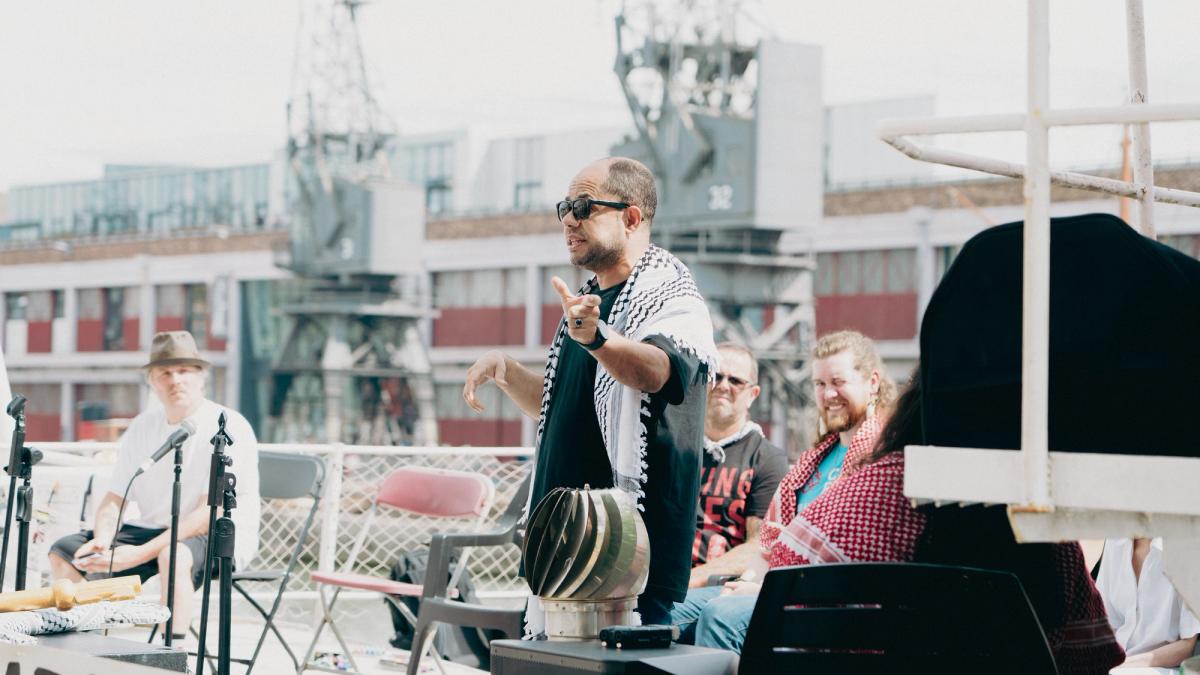
Photo of Ashraf Kuhail by Mitali Shah @_mitulshah
Ashraf Kuhail, Gazan representative of the Bristol Palestine Museum, spent 745 days in the north of Palestine with his 5 children. “It has always been a sign of hope for me, to Gazans and Palestinians,” he says, speaking of the knowledge that people around the world are speaking out, protesting, continuing to journey towards Gaza even after numerous flotillas have been intercepted. “Always gave us power and hope to continue”.
The conversation around Israel’s genocide in Palestine has died down in recent months, if not the past year, but we must continue directing attention to what the people in Gaza and Palestine are enduring each day. The more attention is directed at Palestine, the more pressure we can put on international communities to do what needs to be done. “Spread the word, think about it, try to imagine if you were there.” Alghawazi urges. “We all can support, we are all here, you can speak out, you keep hope alive, you can support direct actioners.” Swee Ang says, “Direct action saves lives”.
I spoke with Romano about trusting your own moral compass over the rules, the mental work it takes. He told me that as a lawyer, a lot of your time is spent finding a way around the laws. During his time representing the Palestinian people at the International Criminal Court, he visited Palestine several times a year, building relationships and connections with the people. He was subsequently banned from travelling to Palestine, so he began attempting to get to Gaza by boat, each time resulting in interception by Israel. While there is still fear of arrest, his love for the people and the land is stronger. “I love the Palestinians like I love my family and my friends. If you don’t fight for those you love – you don’t exist”.
When I ask Frank what gives him hope, he tells me an anecdote from October 2025. The boat Frank was on was intercepted during a mission, and while the Israeli navy was blocking the flotilla, Palestinian fishermen were able to sail further in their own waters and catch fish for their community. He beams, his eyes lighting up as he recounts it.
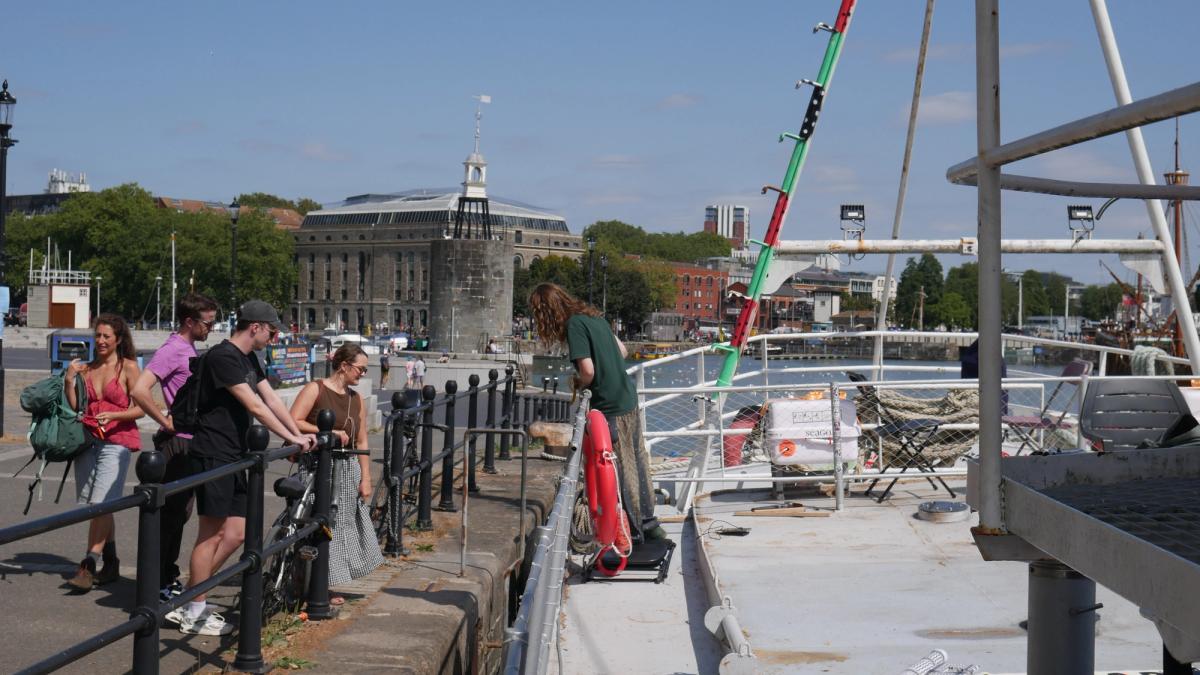
Photo by Oliver Dorman @oliver_dorman
At the heart of everyone’s messages from the day is love for the people of Palestine, and the plea: do anything and everything to help them in any way.
“It falls upon moral citizens to do the duty they [international governments] have failed to do…” Taby Khan from Healthworkers and Allies for Palestine roars, rallying the crowds after the speeches. “Resistance is a duty”.
Speaking to Khan afterwards, she tells us that the Palestinian people have been resisting since the birth of Zionism. What keeps her going is the strength of the Palestinian people who are fighting for their lives, their communities and their land every day. She told me the story of a medical student in Gaza who was living off of one lentil soup every two days. During a class she stepped out for a sip of water. In that moment, a bomb hit and killed everybody there except her – and she had to keep going. Khan told me it isn’t possible to not continue fighting for human rights.
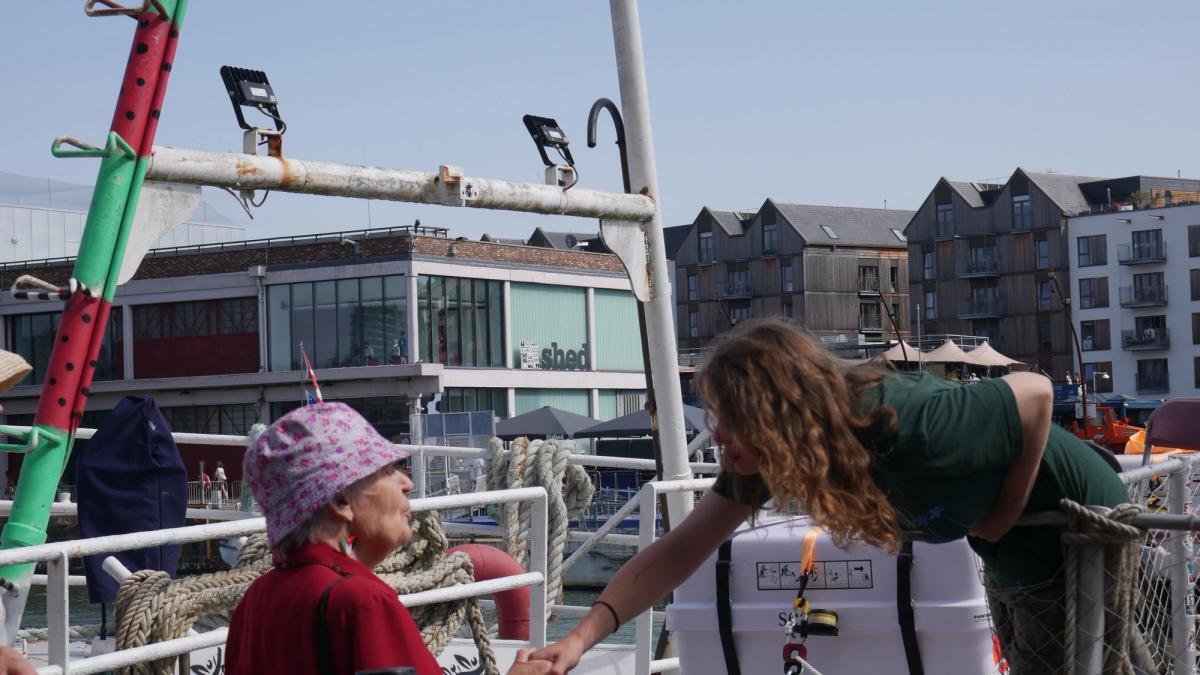
Activist Channon 'Chan' Lawrence helping a visitor onto the boat. Photo by Oliver Dorman @oliver_dorman
Many speakers acknowledge how fighting for Palestinians is integral to our own humanity. As Swee Ang puts it, “If I am a human being I cannot walk away from it”. She reminds us,“They need to live. They need to flourish and see a future. This future is safety, health, education, housing. The same as what we want”. For many who have never been to Palestine, who have not built relationships with Palestinian people, who have only seen the genocide through the news, it is easy to feel disconnected, to feel separated and far away. And to feel hopeless, watching a live-streamed genocide and man-made famine. Kuhail reminds us, “We need statistics for people [to read] here. Wide topics might not be convincing. Look up equipment destruction. There is one MRI device. How many CT devices. It is a conflict zone. We need these statistics. We need to know – twenty thousand patients with cancer are banned from traveling for treatment.” Swee Ang says, “Look at the UN website. Palestinians cannot move in their own country. We have hundreds of trucks waiting to go in. The food is rotting, the medicine is not allowed to go in, our doctors cannot go in. There is a slow way to kill people and the whole world looks away”.
Kuhail continues to share how people can help, telling us: “People need to understand what is going on there: get them involved in supporting education, the Samir foundation, supporting training, these things that help people to survive”. He tells us to keep going, keep talking, keep writing about Gaza. Alghawazi urges us that, “everyone can do even a little”. Everyone can find something they are passionate about – healthcare, education, preservation of art and cultural history, mental healthcare – and can find foundations, projects and people working on the ground in Gaza to support.
We cannot let hope die, let love die, let our anger die. “This is my land,” Kuhail says, “there is something special between me as a human being and my land. They will fail at the end”. He looks at the crew setting sail to Gaza, and says, “I hope to see you hugging Gazans”.
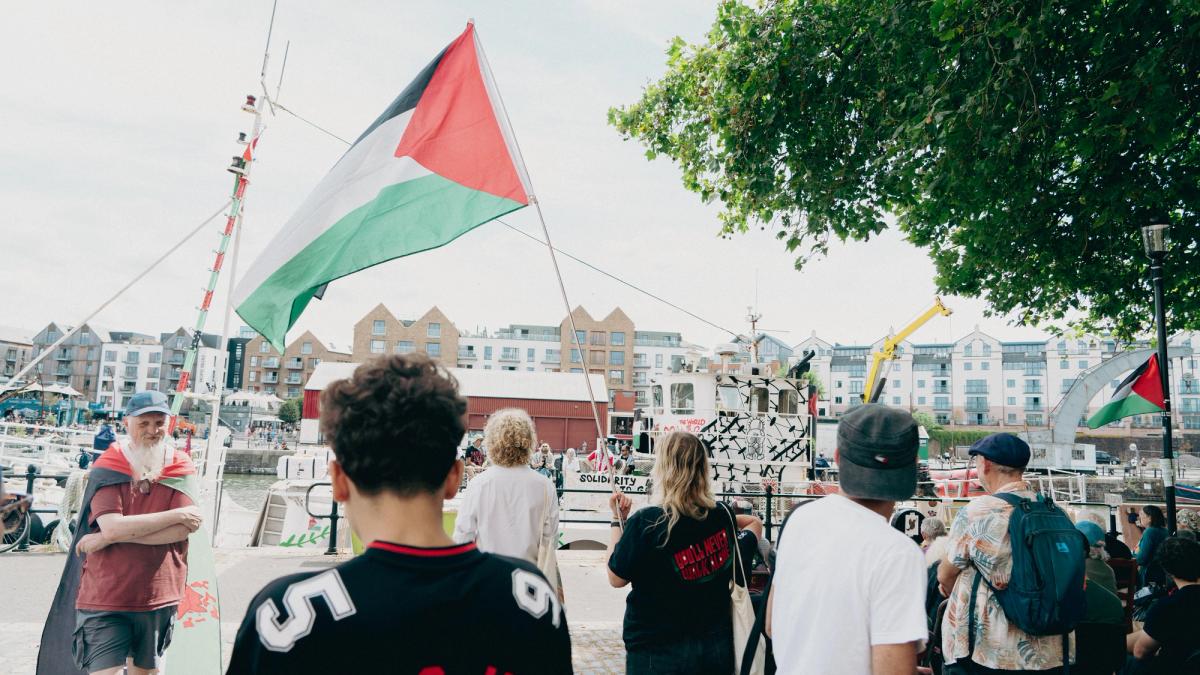
Photo by Mitali Shah @_mitulshah
Now is the time to collectively mobilise - here's what you can do:
- Donate to the Freedom Flotilla Coalition fundraiser
- Track the boat and follow the progress of activists from Bristol and beyond here
- Sign this petition demanding Andy Burnham ends Britain's complicity in Israel's ongoing genocide, illegal occupation, and system of apartheid
More from Creative


